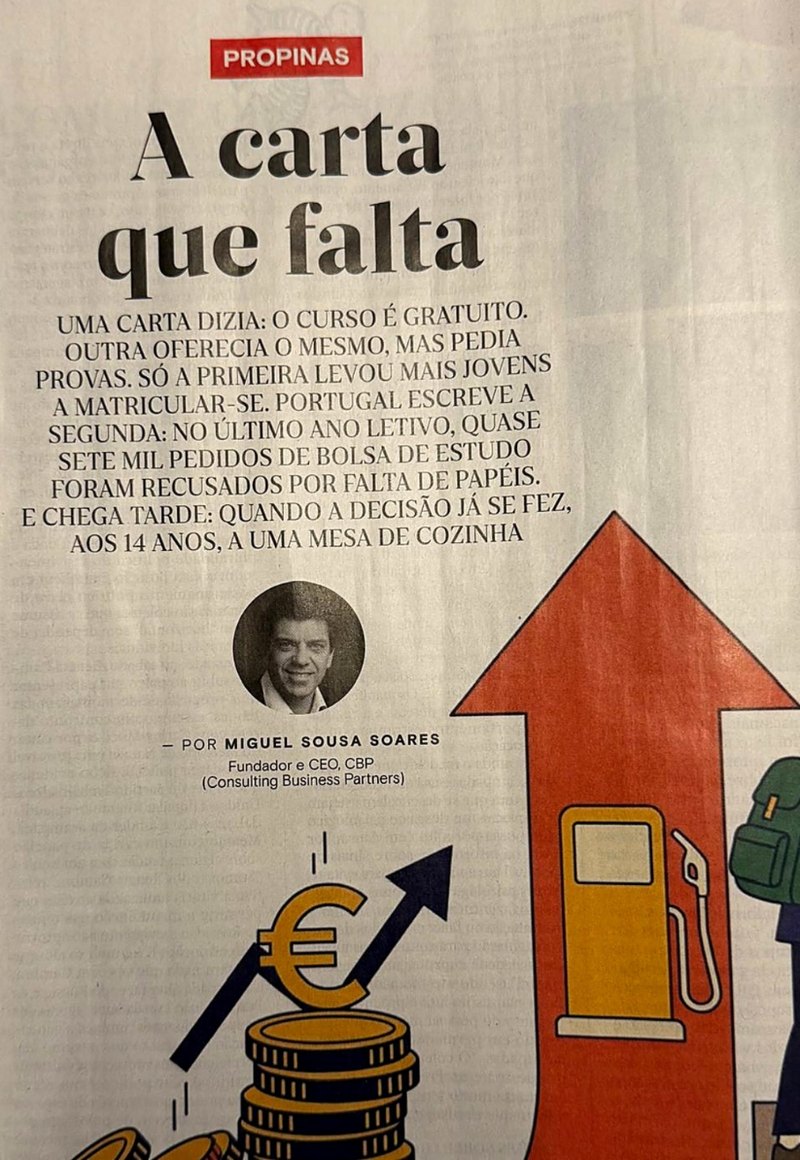
The Missing Letter
One letter said: the degree is free. Another offered the same, but asked for proof. Only the first got more young people to enrol. Portugal writes the second: in the last academic year, almost 7,000 student grant applications were rejected for missing paperwork. And it arrives late: once the decision has already been made, at 14, at a kitchen table.
“This is not about making life easier for students. It is about not losing those who could study.”
In many Portuguese kitchens there is a drawer where the papers that matter are kept. The electricity bills, the income tax return, the letters from the tax office. It is opened with some apprehension, because what goes in rarely brings good news. It brings deadlines. It brings requests for documents. It brings the courteous, cold language of those who need proof before they believe.
One August night, a mother opens that drawer looking for the tax return. Her eldest son has got into a public university. His grades were good enough, the degree is a good one. What remains to be seen is whether the family can cope. The room, the travel, the food, the books and the tuition fee are added up in pencil, on the back of an envelope. On the other side of the table, the youngest, aged 14, pretends not to listen. The grant is still a question. The expenses no longer are.
That is where many are lost, and almost never at the university door. They are lost at the table, without drama and without a record. The young person stays at home, finds a job, puts it off. And putting it off, at 18, can be the polite way of giving up.
I argue that the first public higher education degree should be free in Portugal. The decisive reason rarely enters the debate. More than the price, what holds a family back is not knowing, in time, whether it will be able to pay. A grant only reaches those who prove they need it, and it arrives late. A rule that is the same for everyone asks no one for proof, and that is why it can be known at 14. The right belongs to the student, not to the parents’ tax return. This is not about making life easier for students. It is about not losing those who could study.
Three numbers
- 6,960
grant applications rejected in the last academic year for an “incomplete application”. Almost 1 in every 4 rejections.
(IES 2026) - 26% versus 17%
enrolment at the University of Michigan of high-achieving students from low-income families who received a letter promising free tuition, versus those who received only the usual information. With the letter that asked for proof of income, enrolment did not change.
(American Economic Review: Insights 2023) - €164 million
a year: what the Portuguese government expects to collect in undergraduate tuition fees in 2027. Just over €1 a month per person.
(Draft State Budget 2027; own calculation with INE population)
Tuition fees in the European Union
In 14 of the 27 EU countries, the public bachelor’s degree has no tuition fee. The table compares the others, in euros and at Portuguese prices.
Original bibliographic details (Portuguese)
Publicado originalmente na Visão, edição n.º 1758, de 12 de novembro de 2026, a partir da página 60, com chamada de capa: «Universidade. As propinas são mesmo necessárias?». Esta página reúne os elementos bibliográficos, um excerto do texto e o quadro das propinas na União Europeia.
Main sources
- IES, I.P. (formerly DGES). Map of student grant rejections 2025/2026, as at 6 October 2026.
- Burland, Dynarski, Michelmore, Owen and Raghuraman. “The Power of Certainty”. American Economic Review: Insights, vol. 5(3), 2023.
- Entidade Orçamental. Draft State Budget 2027, tables for the Ministry of Education, Science and Innovation (expected tuition fee revenue).
- Guthmuller and Meroni. “The impact of need-based aid on higher education achievement: Evidence from Portugal”. Economics of Education Review, vol. 110, 2026.
- Bahrs and Siedler. “University Tuition Fees and High School Students’ Educational Intentions”. Fiscal Studies, vol. 40(2), 2019.
- OECD. Education at a Glance 2025 (Portugal; table A1.4).
- DGEEC. School Results: Equity Indicator, Basic and Secondary Education, 2019 (March 2021).
- Federação Académica do Porto. Statement of 15 October 2026 (non-representative survey, 275 participants).
- Bell, Chetty, Jaravel, Petkova and Van Reenen. “Who Becomes an Inventor in America?”. Quarterly Journal of Economics, vol. 134(2), 2019.
- Hauschildt et al. EUROSTUDENT 8, Synopsis of Indicators 2021 to 2024 (figure B7.4); CIES-Iscte and DGES, EUROSTUDENT VIII survey, 2024.
To comment on higher education, tuition fees or student support: contact@consultingbusinesspartners.com
Miguel Sousa Soares is an economist and analyst of geoeconomics and artificial intelligence, with more than twenty years’ experience in strategy and corporate finance. He writes for Visão, Jornal de Notícias, Expresso and Correio da Manhã. He comments on artificial intelligence on NOW on Fridays.